
Notre organisation
Un monde à part, inspiré du Pacifique, recomposé pour notre époque.
Une architecture en quatre niveaux
HCB Tribes est organisé comme un monde à part, inspiré de ce qui marche dans le Pacifique depuis des milliers d’années. À l’intérieur de ce monde, sept clans ; dans chaque clan, plusieurs tribus ; au centre, un siège qui en porte le cœur. Ce n’est pas un schéma théorique appliqué de l’extérieur. C’est une architecture ancienne, recomposée pour notre époque.
Le siège, au cœur
Tout commence au cœur. Le siège porte ce que les clans ne pourraient pas porter seuls : la stratégie, la finance, le droit, le marketing, l’informatique, la maintenance. Il définit le cap, fixe les principes, garantit la cohérence du groupe. Sans lui, chaque clan retomberait dans son silo, isolé et fragile. Avec lui, ils avancent ensemble, en gardant chacun leur pleine énergie sur leur métier. Le siège ne supervise pas, il sert.
Sept clans, autant de métiers
Autour du siège, sept clans : Development, Living, Gourmet, Studio, Lifestyle, Academy, Fondation. Chacun a son métier propre, son identité, sa culture interne. Et chacun est dirigé par un chef de clan, maître de son métier, choisi pour son expertise et pour son alignement avec la vision du groupe.
À l’intérieur des clans, les tribus
Chaque clan rassemble plusieurs tribus, les marques et les projets opérationnels du quotidien. Le clan Gourmet, par exemple, fédère la ferme, le marché, la boulangerie, le glacier, l’atelier de conserves. Chacune de ces tribus a son responsable, son équipe, son métier précis. C’est à ce niveau que se joue le travail réel, au plus près du terrain et du client.
L’intelligence du groupe avant la solitude du chef
Le chef de clan dirige son clan au quotidien. Il anime ses équipes, garantit la qualité du travail, fait grandir ses tribus. Mais il ne décide pas seul : les décisions à plusieurs sont meilleures. Toute orientation stratégique se discute en cercle avant d’être validée par le cœur. C’est ce qui distingue un clan d’un fief : la solitude du chef y est remplacée par l’intelligence du groupe.
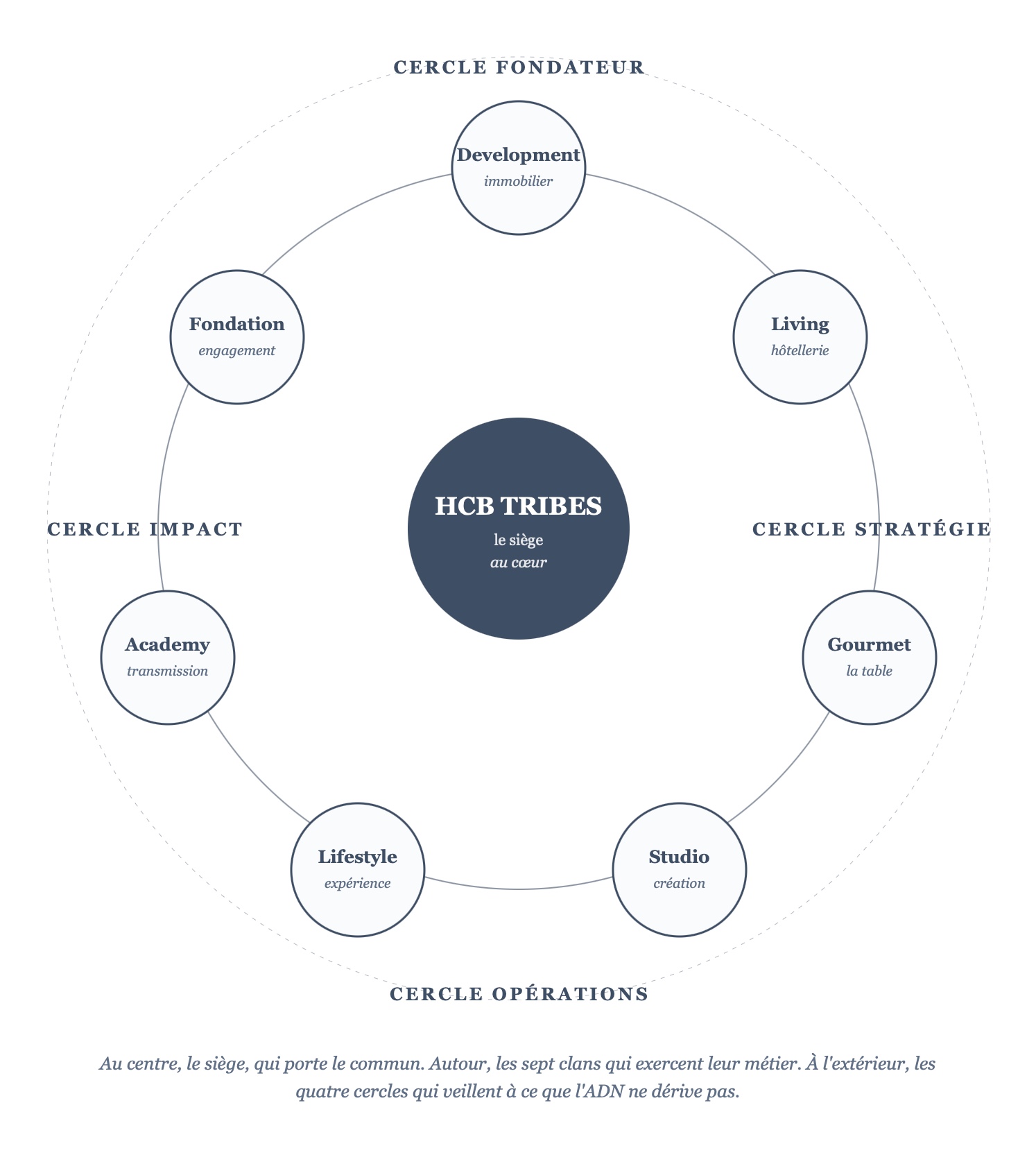
Au centre, le siège, qui porte le commun. Autour, les sept clans qui exercent leur métier. À l’extérieur, les quatre cercles qui veillent à ce que l’ADN ne dérive pas.
Une culture d’écoute large
L’autonomie du chef de clan, et la responsabilité qui va avec, n’ont de sens que parce qu’elles s’inscrivent dans une culture d’écoute large. Sans cette écoute, le chef se retrouverait seul, et c’est exactement ce qu’on veut éviter.
Pas d’ego, pas de titre
Chez HCB Tribes, les bonnes idées peuvent venir de partout : d’un chef de clan, d’un responsable de tribu, d’un apprenti, d’une femme de chambre, d’un fournisseur, d’un client de passage. L’expertise compte, le titre ne compte pas. Tout le monde est au même niveau selon son domaine. Le maître pâtissier sait ce que le chef de clan ne sait pas. Le jardinier sait ce que l’architecte ne sait pas.
Le terrain sait des choses que les chefs ignorent
C’est surtout vrai pour ceux qui sont au contact direct du métier. La femme de chambre entend ce que personne d’autre n’entend. Le serveur voit ce qui ne marche pas avant tout le monde. Le maçon connaît la matière qu’aucun plan ne raconte. Ces savoirs-là, on les écoute, on les recueille, on les fait remonter. Sans eux, aucune décision prise en cercle n’est vraiment éclairée.
Le vis ma vie
Pour que cette écoute ne reste pas un vœu pieux, on la pratique. Régulièrement, chacun va passer une journée ou une semaine dans le métier d’un autre. Le chef de clan va plier des draps avec la gouvernante. Le comptable du siège va aider en cuisine. L’architecte va sur le chantier porter des seaux. Personne n’y échappe, et personne ne s’en plaint, parce qu’on en revient toujours avec quelque chose qu’on ignorait. Pour comprendre un métier, il faut le faire au moins une fois.
Les quatre cercles
C’est sur ce socle d’autonomie et d’écoute que les cercles trouvent leur place. Au-dessus des opérations quotidiennes, quatre cercles veillent à ce que l’ADN du groupe ne dérive pas.
Quatre cercles, quatre vigilances
Chaque cercle a son champ propre.
Le cercle fondateur, le cœur, porte la vision et le cap. Il définit les principes intangibles et valide en dernier ressort toute orientation stratégique. Composé des fondateurs et de quelques sages associés, il est l’instance qui dit ce qui ne se négocie pas. C’est lui, en somme, le chef du grand monde HCB Tribes, non pas une personne, mais un collectif éclairé.
Le cercle stratégie traduit cette vision en orientations économiques. Il palabre sur les investissements, les partenariats, le développement des clans, et soumet ses arbitrages au cœur.
Le cercle opérations suit la mise en œuvre. Il s’assure que les engagements pris se traduisent en actes, que les calendriers tiennent, que les budgets sont respectés.
Le cercle impact, enfin, garde un œil sur ce qui ne se mesure pas seulement en chiffres : l’application de la charte, la qualité du management humain, l’empreinte environnementale, le respect du pays et des cultures. Il inclut un regard extérieur indépendant, parce qu’on tient à ce qu’une voix de l’extérieur puisse toujours dire ce que celles de l’intérieur n’osent plus.
Une géométrie variable
Ces quatre cercles n’ont rien de comités figés peuplés des mêmes têtes à chaque réunion. Leur composition est à géométrie variable : selon le sujet traité, on rassemble autour de la table ceux dont la voix compte sur la décision. Des chefs de clan, des chefs de tribus, des employés terrain qui connaissent le sujet de l’intérieur, et des sages associés, gardiens transversaux choisis pour leur connaissance profonde de l’ADN HCB Tribes, dont la seule mission est de veiller à ce que l’esprit du groupe reste tenu dans les décisions.
Personne n’est convoqué pour la forme ; chacun l’est parce que sa voix compte sur le sujet.
La palabre
Une fois rassemblés, on palabre, ce vieux mot pacifique et africain qui dit la délibération qui prend son temps, écoute tous les points de vue, et ne tranche qu’une fois le consensus mûr.
Tous sont dans la même pièce. La parole circule à tour de rôle, sans interruption, sans monopole, jusqu’à ce que chacun ait dit ce qu’il avait à dire. Puis le cercle décide à son niveau, rend compte au cercle qui le précède, et soumet ses grandes orientations à la validation du cœur.
La charte des chefs de clan
Dans ce cadre d’autonomie partagée, chaque chef de clan porte quatre engagements, signés à son entrée en fonction. C’est ce qu’on appelle la charte HCB Tribes, un texte court, mais qui définit tout ce qu’on attend de lui.
Le métier
D’abord, le métier. Pratiqué au plus haut niveau de son art, sans compromis sur la qualité. Un chef de clan est avant tout un maître dans sa discipline. Sans cette exigence-là, le reste n’a aucun sens.
Le management
Ensuite, le management. Il s’exerce avec bienveillance, respect et tolérance, dans la conviction qu’on prend soin des gens autant que des résultats. Parce qu’on ne peut pas exceller dans un climat triste.
Cette conviction se traduit aussi très concrètement : chez HCB Tribes, la semaine de travail est de quatre jours. Pas parce que c’est à la mode, mais parce qu’on tient pour vrai qu’un employé reposé, présent à sa famille et à lui-même, fait un meilleur travail qu’un employé épuisé. Les expériences menées en Australie, en Nouvelle-Zélande et au Royaume-Uni l’ont démontré ; nous, on en fait simplement un principe.
La transmission
Vient ensuite la transmission. Un chef de clan ne se contente pas de diriger : il forme. Il accompagne ses équipes dans leur progression, partage ce qu’il sait, identifie ceux qui pourront un jour le remplacer ou prendre la tête d’une autre tribu. Pas de tribu sans mentor, pas de mentor sans temps consacré à ceux qu’il forme. C’est ce qui distingue un chef qui domine d’un chef qui élève.
Les services et produits
Enfin, ce que le chef de clan livre au monde : ses services et ses produits. Ils sont conçus dans la fidélité aux principes du groupe : honorer les limites de la planète, honorer la dignité humaine, faire du beau, du bon, du bien-être, et de l’excellence dans le service.
Ces quatre engagements ne sont pas une formalité. Ils sont l’engagement réel qui lie chaque chef de clan au groupe, et qui définit ce qu’on attend de lui.
Une autorité qui sert, plutôt qu’une autorité qui domine
Toute cette architecture, au fond, repose sur une intuition simple : qu’il existe une autre forme d’autorité que celle de la pyramide.
Dans une pyramide, l’autorité descend. Le sommet décide pour la base, qui exécute. Plus on monte, plus on a de pouvoir, moins on touche au métier réel.
Dans un monde tribal, c’est l’inverse. L’autorité circule, et les idées avec elle. Le siège ne dit pas aux clans comment faire leur métier ; il garantit qu’ils puissent le faire bien. Les cercles ne contrôlent pas ; ils palabrent. Les chefs de clan ne sont pas subordonnés ; ils sont responsables et reliés. Personne n’est seul ; personne n’est dominé.
Ce modèle exige davantage. De confiance, de transparence, de constance dans les engagements tenus. C’est aussi ce qui le rend possible à grande échelle, dans la durée.
Our organisation
A world of its own, inspired by the Pacific, redesigned for our time.
A four-level architecture
HCB Tribes is organised as a world of its own, inspired by what has worked in the Pacific for thousands of years. Within this world, seven clans ; within each clan, several tribes ; and at the centre, a headquarters carrying the heart of it all. This is not a theoretical scheme applied from the outside. It is an ancient architecture, redesigned for our time.
The headquarters, at the heart
It all starts at the heart. The headquarters carries what the clans could not carry alone : strategy, finance, legal, marketing, IT, maintenance. It sets the course, defines the principles, ensures the coherence of the group. Without it, each clan would fall back into its silo, isolated and fragile. With it, they move forward together, each keeping their full energy on their craft. The headquarters does not supervise ; it serves.
Seven clans, as many crafts
Around the headquarters, seven clans : Development, Living, Gourmet, Studio, Lifestyle, Academy, Fondation. Each has its own craft, its own identity, its own internal culture. And each is led by a clan chief, a master of their craft, chosen for their expertise and their alignment with the group’s vision.
Within the clans, the tribes
Each clan brings together several tribes, the brands and the operational projects of daily work. The Gourmet clan, for example, gathers the farm, the market, the bakery, the ice cream maker, the preserves workshop. Each of these tribes has its own leader, team, and craft. This is where the real work happens, closest to the field and to the client.
The intelligence of the group, before the solitude of the chief
The clan chief leads the clan day to day. They steer their teams, ensure the quality of the work, help the tribes grow. But they do not decide alone : decisions made together are better. Every strategic orientation is discussed in council before being validated by the heart. That is what distinguishes a clan from a fiefdom : the solitude of the chief is replaced by the intelligence of the group.
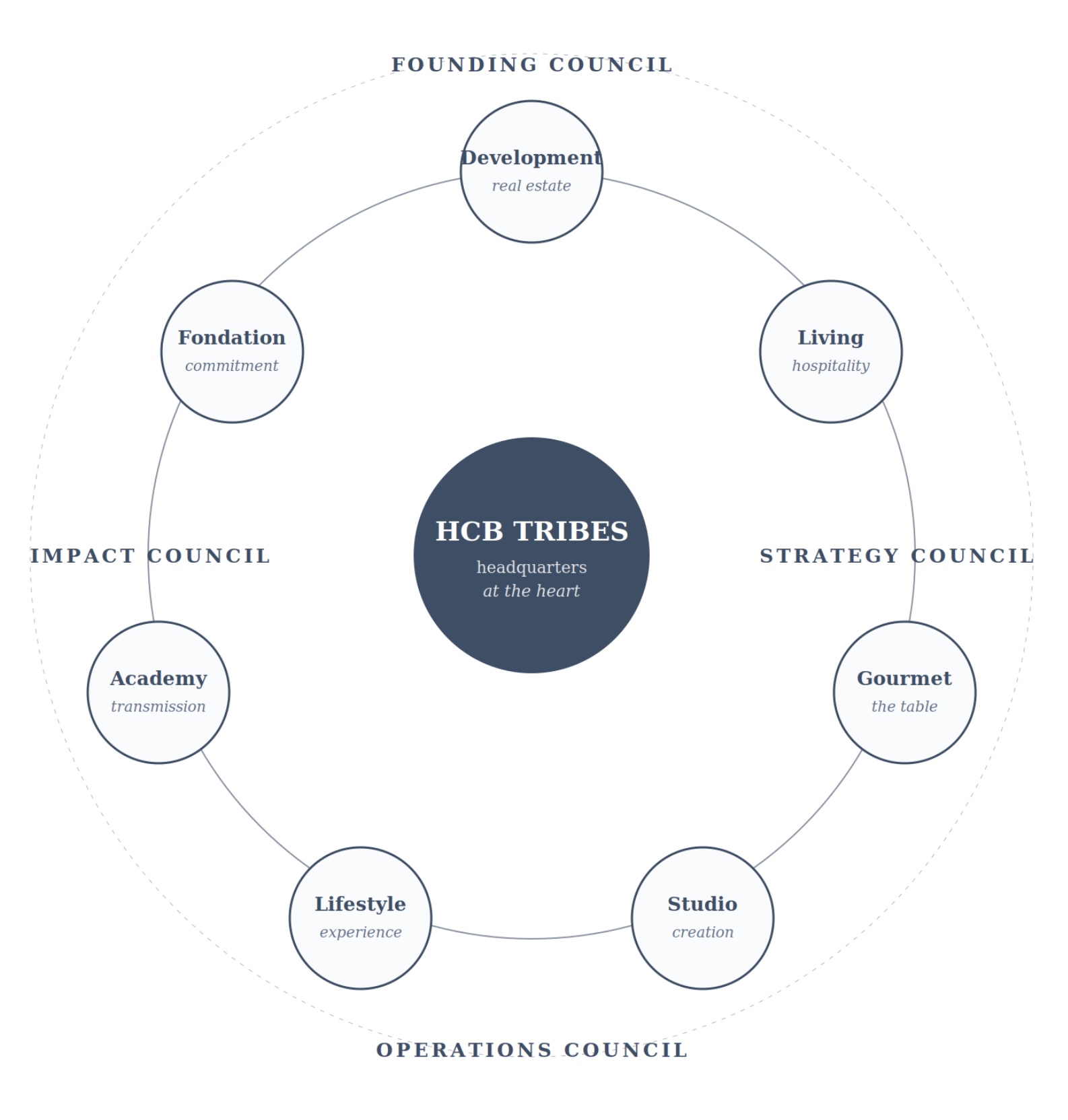
At the centre, the headquarters carrying what is common. Around it, the seven clans practising their craft. On the outside, the four councils watching over the DNA of the group.
A culture of wide listening
The autonomy of the clan chief, and the responsibility that comes with it, only make sense because they are part of a culture of wide listening. Without that listening, the chief would find themselves alone, and that is exactly what we want to avoid.
No ego, no title
At HCB Tribes, good ideas can come from anywhere : from a clan chief, from a tribe leader, from an apprentice, from a chambermaid, from a supplier, from a passing guest. Expertise counts, titles do not. Everyone is at the same level in their own field. The master pastry chef knows what the clan chief does not. The gardener knows what the architect does not.
The field knows what the chiefs do not
This is especially true for those in direct contact with the work. The chambermaid hears what no one else hears. The waiter sees what is not working before anyone else. The bricklayer knows the material that no plan describes. These kinds of knowledge, we listen to, gather, bring up. Without them, no decision made in council is truly informed.
Walk in my shoes
So that this listening does not remain a pious wish, we practise it. Regularly, each person spends a day or a week in someone else’s craft. The clan chief folds sheets with the housekeeper. The accountant from headquarters helps in the kitchen. The architect carries buckets on the construction site. No one escapes it, and no one complains, because one always comes back with something one did not know. To understand a craft, one has to do it at least once.
The four councils
It is on this foundation of autonomy and listening that the councils find their place. Above daily operations, four councils watch over the group so that its DNA does not drift.
Four councils, four watchful tasks
Each council has its own field.
The founding council, the heart, carries the vision and the course. It defines the intangible principles and validates as last resort every strategic orientation. Composed of the founders and a few associated elders, it is the body that says what cannot be negotiated. It is, in the end, the chief of the great world of HCB Tribes, not a person, but an enlightened collective.
The strategy council translates this vision into economic orientations. It palavers on investments, partnerships, the development of the clans, and submits its arbitrations to the heart.
The operations council follows execution. It ensures that commitments translate into action, that calendars hold, that budgets are respected.
The impact council, finally, keeps an eye on what cannot be measured only in numbers : the application of the charter, the quality of human management, the environmental footprint, the respect for the country and its cultures. It includes an independent outside view, because we hold that a voice from the outside should always be able to say what those from the inside no longer dare.
A variable geometry
These four councils are nothing like fixed committees populated by the same heads at every meeting. Their composition is of variable geometry : depending on the topic, we gather around the table those whose voice counts on the decision. Clan chiefs, tribe leaders, field employees who know the subject from the inside, and associated elders, transversal guardians chosen for their deep knowledge of the HCB Tribes DNA, whose sole mission is to ensure that the spirit of the group remains held in every decision.
No one is summoned for the form ; each is there because their voice counts on the subject.
The palaver
Once gathered, we palaver, that old Pacific and African word for the deliberation that takes its time, listens to every viewpoint, and only decides once the consensus is ripe.
Everyone sits in the same room. The word circulates in turn, without interruption, without monopoly, until each has said what they had to say. Then the council decides at its level, reports to the council that precedes it, and submits its major orientations to the validation of the heart.
The clan chiefs’ charter
Within this framework of shared autonomy, each clan chief carries four commitments, signed upon taking office. This is the HCB Tribes charter, a short text, but one that defines everything we expect from them.
The craft
First, the craft. Practised at the highest level of one’s art, with no compromise on quality. A clan chief is above all a master in their discipline. Without that demand, nothing else makes sense.
Management
Then, management. Practised with kindness, respect and tolerance, in the conviction that one cares for people as much as for results. Because one cannot excel in a gloomy atmosphere.
This conviction translates very concretely : at HCB Tribes, the working week is four days. Not because it is fashionable, but because we hold it true that a rested employee, present to family and self, does better work than an exhausted one. The experiments conducted in Australia, New Zealand and the United Kingdom have shown it ; we simply make it a principle.
Transmission
Then comes transmission. A clan chief does not only lead : they teach. They support their teams in their progression, share what they know, identify those who could one day replace them or lead another tribe. No tribe without a mentor, no mentor without time given to those they teach. That is what distinguishes a chief who dominates from a chief who lifts.
Services and products
Finally, what the clan chief delivers to the world : their services and products. Designed in fidelity to the group’s principles : honouring the limits of the planet, honouring human dignity, making beauty, goodness, well-being, and excellence in service.
These four commitments are not a formality. They are the real engagement that binds each clan chief to the group, and that defines what is expected of them.
An authority that serves, rather than an authority that dominates
All this architecture, in the end, rests on a simple intuition : that another form of authority exists than that of the pyramid.
In a pyramid, authority descends. The top decides for the base, which executes. The higher one climbs, the more power one has and the less one touches the real craft.
In a tribal world, it is the opposite. Authority circulates, and ideas with it. The headquarters does not tell the clans how to do their craft ; it ensures they can do it well. The councils do not control ; they palaver. The clan chiefs are not subordinated ; they are responsible and connected. No one is alone ; no one is dominated.
This model demands more. More trust, more transparency, more steadiness in commitments kept. It is also what makes it possible at scale, over time.